Showing posts with label bulbs. Show all posts

Sunday, July 12, 2009

Double Flora Pleno Tiger Lily

Once again, sorry for the delay in blog postings. I've been fighting an uphill battle with my health for the past eight months, the last three the most arduous simply because I could not find good medical help. Finally, I've found a combination of doctors which I believe have my best interest in mind instead of an interest only in the amount of money to be made. Now, having shared that much---possibly TMI---I'm on new meds, I'm already feeling better, so let's hope I can better divide my time between gardening and writing about gardening!

As most of you know, I love all things garden and the more whimsical the better. So at the end of last summer, when I was perusing garden catalogs and came upon the double flora pleno tiger lily, I knew it was a must have for Blessing Hill's gardens. Right away, I filled out an online order and could barely wait to receive email confirmation that my order had been received. Keep in mind, when ordering some bulbs, the time of year depends on the time of shipping. Usually, lilies ship in the fall so they can be planted and overwinter. Needless to say, I waited all winter to see these awesome creatures. It was worth the wait! I had no idea how prolific the blooms would be and no idea the lasting power they would have. They have been spectacular.

Each flower has 24-36 petals that unfurl to reveal that gorgeous orange color and all those fiesty black freckles. What was really surprising to me was each three foot stem produced a half a dozen blooms per.

I found these bulbs at Van Bourgondien's. I'd like to share my experience with you. I placed a fairly sizeable order and everything but the tiger lilies arrived first and in great condition. When the tiger lilies arrived, I was terribly disappointed. The bulbs were soft and mushy. I found it odd that all the other bulbs were fine albeit the tiger lilies. I did some investigating. I could not fault Van Bourgondien's. The first shipment was sent directly from their business through regular mail and arrived just fine. However, when the tiger lilies were shipped, they went through a delivery service that dropped off at the post office and then routed them out. When I talked to customer service, I pointed out the difference. Not only did Van Bourgondien's ship me all new bulbs, they shipped regular mail, and didn't ask me to return the damaged bulbs. When the second set of tiger lily bulbs arrived, they were fresh and went directly into the ground. To let you know the quality of their bulbs, I planted the damaged tiger lilies, not expecting good results. Every last one came up and bloomed just as beautifully as the second set.

Thursday, June 11, 2009

For the Love of German Bearded Iris

Sunshine & Snow I can't imagine a cottage garden---or any other garden for that matter---without the presence of German bearded iris. I remember when I first fell in love with these rhizomatous perennials. A few blocks from my childhood home lived a woman who tended an extremely large iris kingdom. I don't think she had need of a lawn mower because the iris had taken over every patch of ground but what the house sat upon. In May, her yard was a riotous canvas of brilliant color. Now, all these years later, I can't imagine just how many different varieties her garden had held. That was in the '70's

Clarence Magical Encounter

Turn the dial forward a few decades to 2001. The first house David and I bought after moving to the Kansas City area was one which had been owned previously by a gardener. Our first spring came with lots of surprises as we watched perennials emerge in all the different beds around the house, but the most spectacular were the iris. The second spring, I noticed they didn't flower nearly as profusely. The clumps of foliage were jam packed together in spots and bare in others among the bed. I decided it was time for reorder and after all the blooms were gone, I sat about digging up all those rhizomes. Mind you, the beds were 4' wide by close to 25' long, on two sides of the house, the west and the east. It was going to take some back breaking work to get it all back to right.


Harvest of Memories
Ecstatic Echo


Nevertheless, I began digging. I had rhizomes all over the yard by the time I was done and the flower bed looked like it had been pelted with mini bombs, large craters where iris once resided now hollow and empty. But, not for long. I grabbed a sharp knife and began the arduous task of dividing. I cut those gnarled, overgrown rhizomes into many manageable pieces. By the end of the day, all were back in the soil, ready to take root. I have to say, that next spring was one technicolor flower show! Many new hues emerged that had not bloomed previously due to overcrowding.


Cherub's Smile
Rave On


Last fall, I went on an iris buying frenzy. I had only three varieties at this property up to that point. As soon as the nurseries brought out their fall bulbs, I was there to nab one of every color. Twenty-nine new varieties went into Blessing Hill's gardens. I share some loveliness and grace with you . . .
Rare Treat

Here's what you need to know if you are interested in growing iris:

Red Hawk


Dusky Challenger


Iris lacks the gene for red pigmentation---Red Hawk getting as close to a red hue as possible. However, iris comes in a huge variety of shades from the palest white to the blackest of midnight blue. They require full sun in well drained soil but believe me, I have iris that do well in the most clay-filled areas of my gardens. Given a light fertilzer in early spring and again in late summer, is really all the maintenance needed. They are extremely drought tolerant. Often, iris can be found growing in ditches on county roads, requiring nothing from no one. I plant my iris between June and September. Iris should be divided about every three to four years to prevent overcrowding.

Rhizome division is essential to flowering. Once iris become crowded, dig carefully around the entire plant and lift from the ground. Brush away excess dirt and examine the rhizome. The rhizomes should be solid and firm. Rot is foul smelling and mushy. If any part of the rhizome displays rot, cut away and discard. (Dip knife into alcohol after cutting away rot so that it is not passed on to other rhizomes.)I like to divide a large, healthy rhizome into three or four parts. Once division is done, allow rhizomes to dry for a few hours in direct sun light. Replant in soil ammended with coarse sand for ideal growing conditions.

Wednesday, February 4, 2009

Tigridia: aka Mexican Shell Flower

This beauty is also known as Mexican daylily, sacred Aztec lily, sacred tiger lily, peacock flower, tiger flower, and flower of Tigris. How interesting. I know just how it feels carrying around so many different names. I recently had some business with my bank last week in which I was asked to sign two different documents verifying that I had used a string of various aliases and that I was indeed same and said person. The lists went something like this:

first name, maiden name
first name, middle initial, maiden name
first name, middle name, maiden name
first name, married name . . . blah, blah, blah! Tiresome.

The other thing I have in common with tigridia is that we both are lovers of warm weather, tigridia more so than me which leads to a parting of our ways. Whereas I can withstand temperatures below 22 degrees, albeit not for long, Tigridia cannot---oh, really??? Guess again. The tigridia in the above picture is three years old or, it's been planted for the last three years against the south facing foundation wall of our house. (I have no idea how old the corm was when I bought it.) The first year, it sent out three leaves and a single flower. The second year it doubled in size, put up a few more leaves and flowered both yellow and orange flowers. This past season, it flowered pink, yellow, orange, and red---one to two flowers at a time. Yes, it is definitely an anomaly.

In fact, it is an anomaly in more ways than one. Tigridia is sparsely planted by gardeners because its bloom lasts only one day. I can attest to that. I've learned to get my camera the moment I see it in bloom or else I'll forget and have to wait another year to take its picture. That's how fragile its flowers are.

The particular species pictured is actually Tigridia T. Pavonia. It's one of 23 species native to South and Central America. The foliage is spiky but thin and flowers are borne on delicate stems. In the wild, tigridia are naturally pollinated by hummingbirds. They are easily cultivated as long as they are planted in well drained soil in full sun, zone 8.

So why am I able to grow tigridia here in zone 5 without lifting the corm from the ground each fall? Just a guess but, my tigridia is planted beneath the voluminous, leafy skirt of a hemerocallidaceae (daylily). In the fall, I don't cut the daylily back but allow its foliage to decompose back into the ground. Maybe that foliage protects the tigridia corm. Secondly, the tigridia corm is planted close to the south facing foundation wall. And when it is in bloom, I notice how the praying mantis and honey bees in my garden tend to favor it. As exotic as an orchid, tigridia always gets plenty of oohs and aahs!

Saturday, December 20, 2008

Spring Arrives in a December Mailbox

Like most of the country, here in Harrisonville (just south of Kansas city), we are hunkering down for a big freeze. The high for the Chiefs game tomorrow will be a whopping 8 degrees---with any luck. My husband, David, double checked antifreeze strengths in all three cars, something he's done only twice in the eighteen years we've been together. And, I would say this is definitely going to challenge all those marginal zone 6 perennials I planted on the advice of nursery people who assured me that our winters aren't as cold as they once were. Needless to say, and according to our weather forecasts, it's going to feel like Alaska around here for the next few days.

So imagine my delight when I opened my mailbox this afternoon and saw the vibrant, rich colors of a spring seed catalog staring out at me!!! Thrilling. And less than a week from Christmas! What caught my eye was the picture of a red and white marbled grandiflora rose called Rock & Roll. I saw this rose at The Family Tree nursery last summer. Not to be harsh, but seeing the rose in person was less spectacular than seeing it splashed across the front page of my new seed catalog. The roses were small and the variations of color weren't nearly as striated. Anyway, my mailbox is about 75 feet away from my front door. It seemed like an eternity to reach the mailbox with the bitter north wind whipping around my exposed face but with seed catalog in hand, the trip back to the house didn't seem nearly as miserable or lengthy in duration!

Tossing all other pieces of mail aside, I sat down at the kitchen table and started perusing the pages. Of course, have-to-haves immediately began jumping out at me. I'm particularly excited about a new Gaillardia called Dakota Reveille. It's the first double ball-type I've seen to withstand temperatures to zone 4. Yipppeee!!!!!!!! I have perennial Gaillardia but they are the more daisy-like type in appearance. And I love to grow Cosmos every year. I try to find a new and exciting variety to experiment with. This year, looking at the seed catalog, it appears that Double Click Rose Bonbon may just be the ticket. The blooms are fully double, rose/lavender petals borne on 36 inch stems. Perfect for the back of the border. I also have my eye on a clematis called Empress. This variety, with its candy-pink double blooms, which have darker pink midrib markings and a spiky pompon center, would be a great addition to my clematis collection. It doesn't hurt that Empress is also my favorite flower color!


As my eyes scanned the delightful pages of the seed catalog, they came to rest on the word bulbs.That's when I was ripped from my futuristic daydreaming and jarred back into the present. During the winter, my garage rarely dips below 40 degrees. However, with a wind chill factor of -20, I need to get off this computer and start helping David tote my stored bulbs to the basement.

Wednesday, December 3, 2008

Lu and Me in the Garden

Meet my garden companion, Lu. Isn't he a handsome fellow?


Dave and I adopted Lu three years and two months ago from a rescue program. He's a wonderful dog. Unfortunately, someone treated him very poorly before he came to live with us. He has a lot of fear. He doesn't warm up to strangers and is leary even with our neighbors and friends. Lu is a mix of Boxer and German Shorthair---he's so dashing he often garners compliments when people see him. He loves to be in the gardens when I'm outside. More often than not, he stands guard while I dig or plant. He takes protecting me very seriously. However, he can be distracted by the lure of a discarded plastic pot. I think that as soon as I remove the plant and lay the pot on the ground, the pot begins to call his name in a voice only he can hear. Sneaking up on my blind side, Lu will then ease the pot up off the ground until he has a sure grip with his teeth. And that's when he explodes into a frenetic mass of churning muscle. Round and round the yard he runs, turning and twisting, leaping and lurching, the pot dancing on the end of his nose. We've given him all kinds of store-bought toys but nothing is as much fun as the discarded plastic pot.

Yesterday, we planted the bulbs I got at Ace hardware last weekend. They were beautiful and solid and much to my delight, I found that the ground was still dig-ible. Into the ground went 10 Anemone Blanda, 4 Nectaroscordum Allium, 20 Dick Wilden Double Narcissi, and 7 Mount Everest Giant Allium. Much to Lu's delight, he found the remnants of a flower pot and after running with it until he tired himself out, he settled in for some shredding. He's also very proficient at making plastic confetti.

While I was planting the bulbs, I remembered reading a helpful planting tip about bulbs that I wanted to pass on. Sometimes it's hard to tell, especially for beginning gardeners, which is the top and which is the bottom of the bulb for placement in the ground. Almost always the top is pointy. But, if you can't figure it out, plant the bulb on its side and the bulb will take care of itself. Nice.

Today, we are expecting snow. Not a lot, maybe an inch. But Lu and I don't care for the gray skies and the bitter way the wind has turned on us from the northwest. Maybe that's why I'm sitting here jabbering about dogs and bulbs and Lu is chasing rabbits from the comfort of his recliner.

Monday, December 1, 2008

Christmas lights and spring flowering bulbs

Winter came again to Kansas City and all at once. Some of us just weren't ready---me, for one, and this poor scabiosa who was caught blooming unaware.

Frankly, I don't know how it was still producing viable blooms. We've had several nights of freezing temps---dipping down as low as 18---but I guess our mild days kept it encouraged. This Wednesday our forecast calls for temps in the upper 50's. No wonder some of my hardier plantings are confused. And talk about confusion, this past weekend I walked into my local Ace hardware store in search of a 50 count string of green twinkle lights and ran smack into a display of spring flowering bulbs! (What were they still doing on the shelf?)

Needless to say, my husband, who'd been abandoned before we ever reached the Christmas section, found me sorting through little cardboard bins of tulips, daffodils, and hyacinth bulbs, twinkle lights all but forgotten. "I should have known," was the first thing he said, a familiar form of greeting between us when my gardening obsession derails me from my intended path. Then he asked, "Will these be okay to plant now?" At 90% off the original price, I assured him it was worth taking a chance. When will I ever again get the opportunity to buy Mount Everest Allium bulbs for roughly 30 cents each? And, if they do make it, how great will they look scattered throughout the gardens? Awesome!

Later, dressed in sixteen layers of clothing, I tottered out to the gazebo and helped string lights along its rails and posts while the north wind stabbed the exposed skin of my face with ice pellets. That's when I noticed my scabiosa, the same plant I bought half dead in the late summer from a local nursery for 75% off. Once I put it in the ground, it flourished. Hopefully, this coming spring, I'll be able to post a picture of giant snowballs sprouting from a warm sun drenched garden bed.

Wednesday, October 22, 2008

A Time to be Dormant

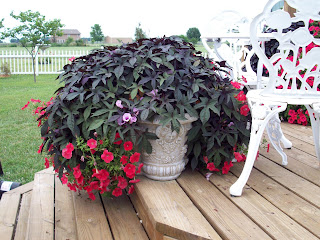
Sadly, it's that time of year here in the Midwest to dig the bulbs, tubers, and rhizomes from the garden beds. It's not the digging that saddens me as much as the cutting back of a season's worth of carefully cultivated foliage. Let's face it, for the last five months, I've coaxed, cajoled, and pampered Ipomoea Blackie and its companion red supertunia to flourish and conceal the containers in which they are planted through a stringent schedule of feeding and watering. blackie sweet potato vineSo goes it for the luxuriant upright elephant ears, the oxalis, the pineapple lilies, etc. After a few quick snips with the clippers, all are reduced to clumps of stubbly green stalks.

Unfortunately, these tropicals and I are kindred spirits. We reside in a climate that forces us into a period of dormancy. Morose? Maybe a bit. Hopeful? Always. While I trade in my shorts, t-shirts, and flip flops for sweaters, jeans, and boots, my bulbs, tubers, and rhizomes trade their sunshine and rich soil for layers of mulch in containers that protect them from freezing. But, no matter how long this coming winters draws, inside there's still an energy quietly waiting to sprout forth into a new spring!

Money saving tip: Underneath all that lovely foliage of the ipomoea (Blackie, Marguerite, Ace of Spades-- just to name a few) is a wealth of potential new plantings for spring 2009. All summer long, those beautiful vines have been producing tubers beneath the soil. After I cut back the foliage, I carefully mine through the dirt and extract the potatoes. I never know what to expect to find and this year was no exception. One of my Marguerite vines produced a 6 lb, 2 oz tuber!!! After I've extracted all the tubers, I let them dry out for a few days in my laundry room and then I store them like any other bulb in the cool darkness of my garage. In late March, I pot the tubers and place them in a sunny window to get a head start on the planting season. It doesn't take long for the dormant tubers to wake up. As soon as there is a succession of nightly temperatures in the 50's, they are ready for outside planting.

Green tip: I particularly like to turn all the excess, non-woody foliage sheared from bulbs, tubers, and rhizomes into rich compost. I particularly like to compost elephant ear greenery. The high moisture content in the leaves and stalks is a plus in the compost bin.